 Algae Outer Hebrides
Phylum: Charophyta Family: Desmidiaceae
Cosmarium venustum (L.A. de Brébisson) W. Archer 1861
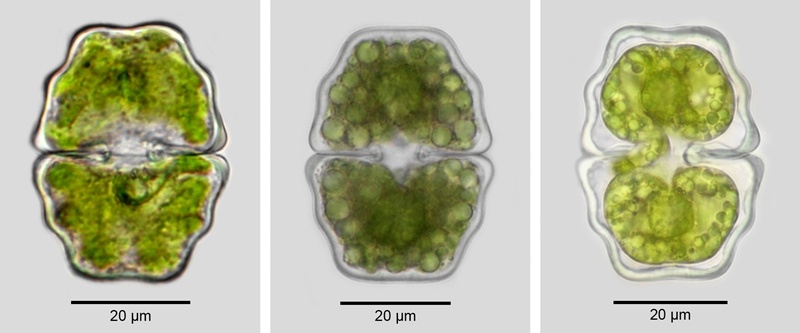
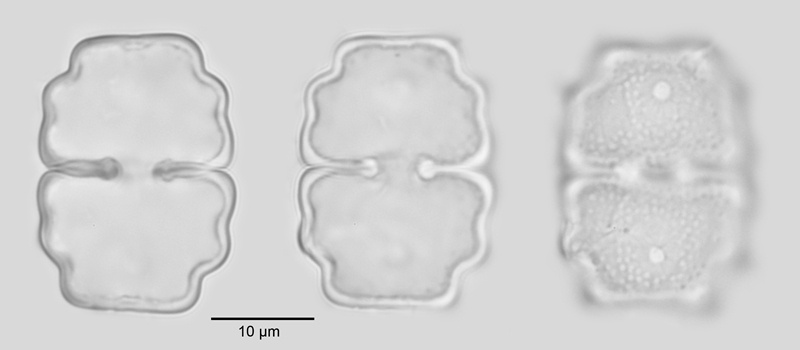
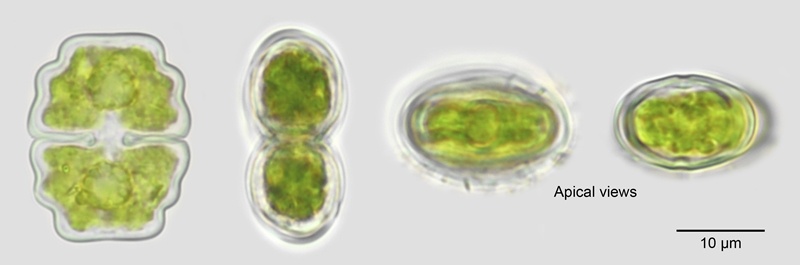
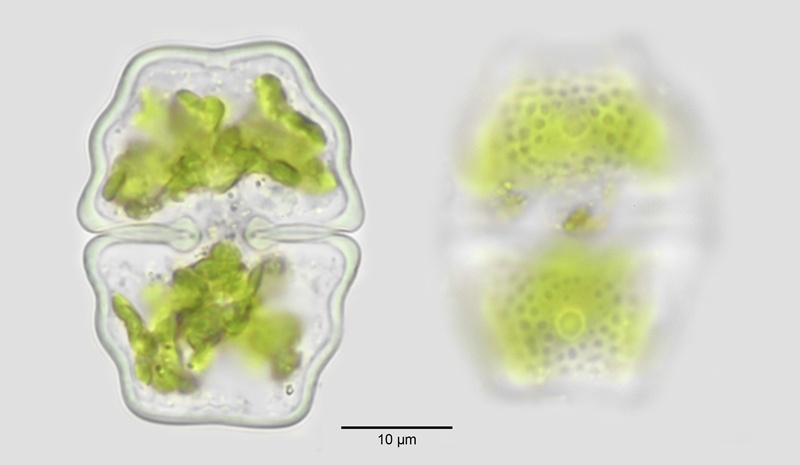
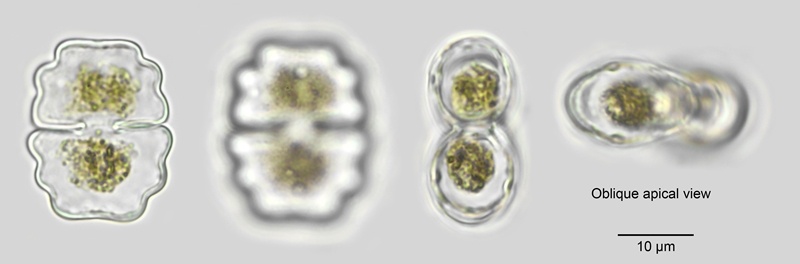
There are two distinct sizes of this taxon, which is reflected in their shape. Both are truncate-pyramidate with the smaller cells having a protracted apical section which is truncate and faintly retuse. The larger cells are more pyramidate with the sides converging to a relatively narrower apex. The apical angles are well rounded giving the apex a saddle effect in many cells. These larger cells are also much thicker walled. In both sizes the cell-wall is scrobiculate with a larger scrobiculus about two-thirds up from the isthmus. There is also a distinct demarcation in the cell dimensions:
Small form: L: 23.6-26.7 µm; B: 18.1-19 µm; Is: 4.6-5.6 µm; Th: c.11.2 µm; L/B: 1.24-1.41.
Intermediates: (2): L: 32.1-35.3 µm; B: 24.7-27.1 µm; Is: 7.1-7.2 µm; Th: c.13 µm; L/B: 1.30-1.43.
Large form: L: 41.6-45.8 µm; B: 29.9-33.9 µm; Is: 6.6-10.8 µm; Th: c.17 µm; L/B: 1.23-1.43.
Van Westen (2024: 372 – as C. venustum var. excavatum) only records the smaller form and his dimensions fit comfortably with mine. The significant measurement is the isthmus which has no overlap. The rare intermediates should be attached to the larger form based on the isthmus and the fact that they were particularly thick-walled.
I think there are two separate taxa here but will await more data: I’m short of side and apical views.
A widespread and common species in the Outer Hebrides, with a bias towards the larger forms. Found in acidic, oligo-mesotrophic, habitats.
References:
Kouwets, F.A.C. (2025). European Flora of the Desmid Genus Cosmarium. Part 1: Text. Part 2: Plates.
Van Westen, M.C. (2024). Sieralgen in Drenthe.