 Algae Outer Hebrides
Phylum: Charophyta Family: Desmidiaceae
Cosmarium venustum var. hypohexagonum W. West 1892
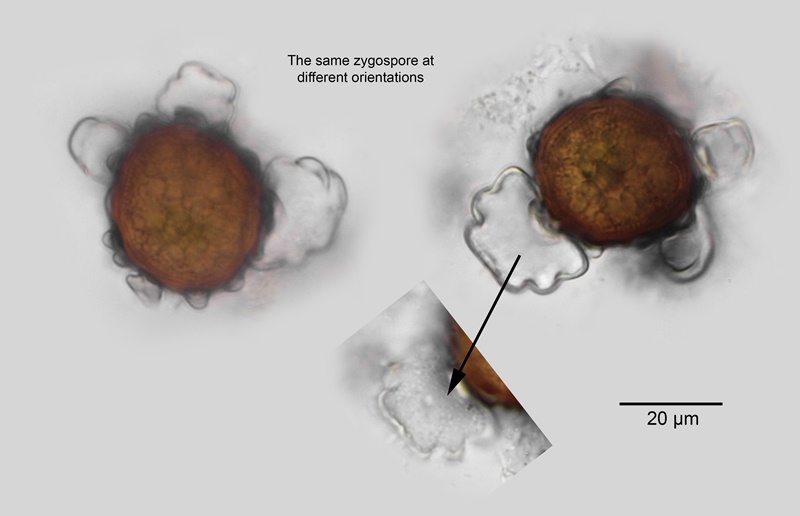
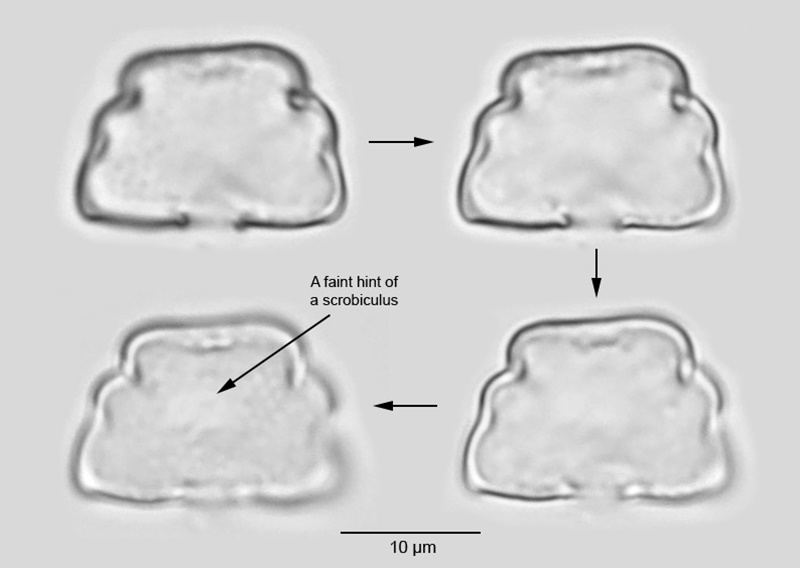
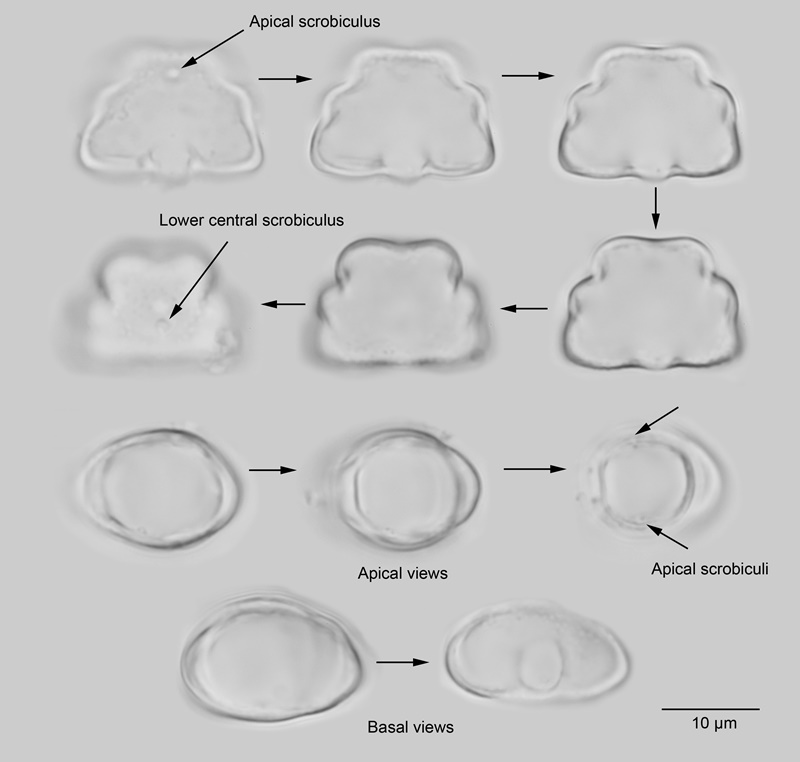
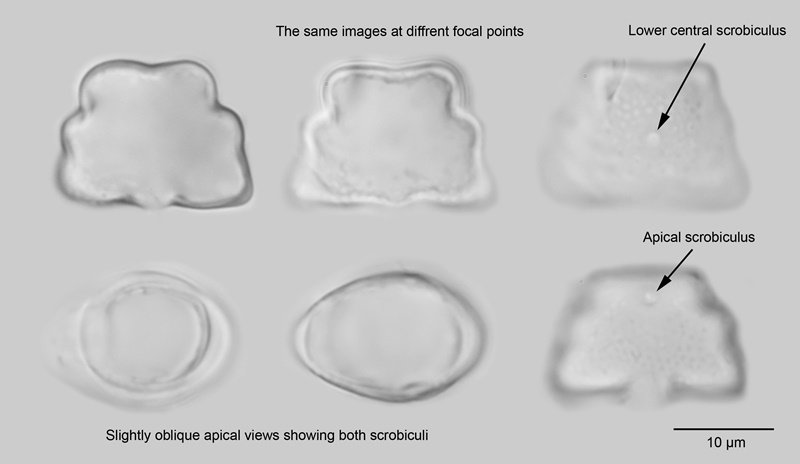
Cells medium-sized, longer than broad, sinus dilated at the apex, otherwise closed for the most part. Semicells truncate-pyramidate in outline, the lateral margins tricrenate. The central lateral lobe is twisted: following the line of the apical lobe, it disappears behind the central lobe, which is projected forwards. The lower part of the central lobe is projected away, disappearing behind the basal lobe. In face view, this overlapping of the lobes gives the impression that the indentations are thickened (perceived and possibly actual). The cell-wall is thick and uniformly covered with medium scrobiculi. Central to the vertical axis are two medium-sized scobiculi; one below the median line, the other just below the apex. The apex is truncate and slightly retuse. Zygospore dark brown, sub-globose with mamillate protuberances, some with an irregular outline, 10-12 visible around the perimeter in face view.
Cell dimensions: L: 26.4-33.4 µm. B: 19-25.2 µm. Is: 4.1-5.0 µm. Th: c.12.2 µm. L/B: 1.33-1.46.
Zygospore (overall dimensions): 38.4 x 33.3 µm.
First described and illustrated by West (1892: 148, pl. 24: 23). “A subtricrenate form, perhaps a thickened membrane between the undulations.” (As single dimensions are given it would suggest that just a single cell was found.) By the time W. & G.S. West had produced their five-volume flora, they had merged the forma incrassata with the nominate variety and gave a much broader size-range: L: 25-38; B: 20-25; Is: 5-8.5; Th: 11-16 µm. (1908: 10, pl. 56: 5-6).
There is nothing to suggest that more than one cell of forma incrassata is involved here but comparing the original drawing with the later one in the flora, it has changed from being very slightly indented with some thickening at the bases, plus a truncate apex to more marked indentations and a noticeably indented apex. No explanation is given. I believe this taxon deviates far too much from C. venustum and would be better redesignated.
References:
Kouwets, F.A.C. (2025). European Flora of the Desmid Genus Cosmarium.
West, W. (1892). A contribution to the freshwater algae of west Ireland.
West, W. & West, G.S. (1908). A Monograph of the British Desmidiaceae, Volume 3.